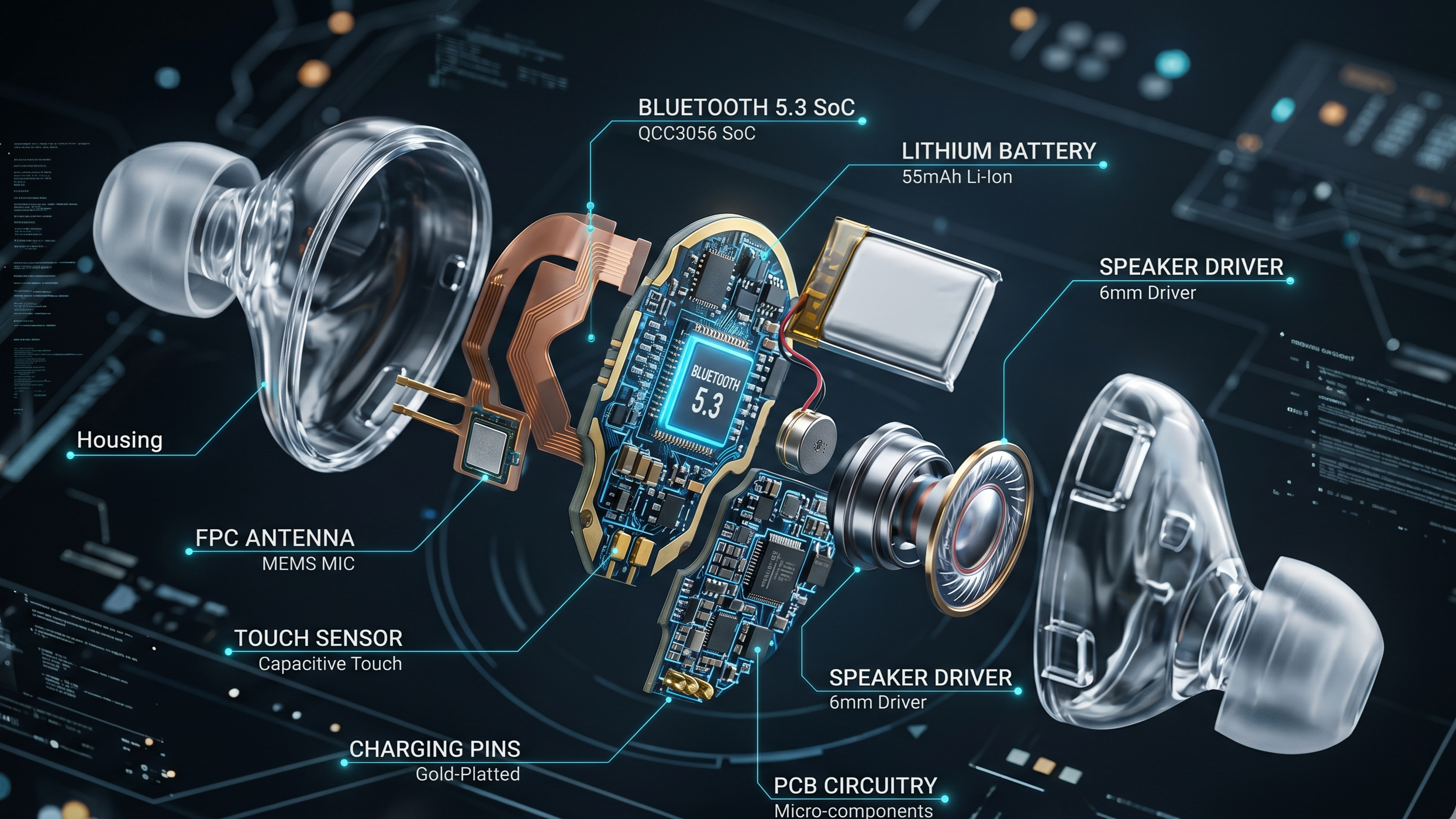
Inside Wireless Earbuds — How Tiny Computers Fit in Your Ears
Wireless earbuds may look simple from the outside, but inside each tiny bud is an astonishing combination of advanced electronics, battery engineering, wireless communication systems, and acoustic design.
These pocket-sized devices are far more than speakers — they are miniature computers designed to process sound, communicate wirelessly, cancel noise, and manage power, all while fitting comfortably in your ear.
So how does all this technology fit into something smaller than a coin? Let’s open them up.
The Tiny Marvel in Your Ear
Modern True Wireless Stereo (TWS) earbuds combine multiple technologies into an ultra-compact form:
- Bluetooth communication
- Audio processing
- Battery charging
- Microphones
- Sensors
- Antennas
- Speaker drivers
Every cubic millimeter is engineered for maximum efficiency.
The System on a Chip (SoC) — The Brain of the Earbud
At the core of every wireless earbud is a tiny Bluetooth SoC.
What It Does:
- Connects to your phone via Bluetooth
- Decodes audio signals
- Processes microphone input
- Controls touch commands
- Manages battery power
- Enables Active Noise Cancellation (ANC)
Common Features:
- Bluetooth 5.0 / 5.3
- AAC / SBC / aptX codec support
- DSP (Digital Signal Processing)
This chip is essentially a mini smartphone processor optimized for audio.
Bluetooth Antenna — Invisible Wireless Communication
Each earbud contains a miniature antenna that communicates with:
Primary Connections:
- Your smartphone
- The other earbud
- Charging case (sometimes)
Why It Matters:
Better antenna design improves:
- Connection stability
- Range
- Latency
- Battery efficiency
Tiny size makes antenna placement extremely difficult — this is one of the biggest engineering challenges.
Speaker Driver — Turning Electricity into Sound
The driver is the component that actually produces sound.
Types:
Dynamic Drivers:
- Better bass
- Common in most earbuds
Balanced Armature Drivers:
- Better detail
- Often in premium earbuds
Hybrid Systems:
- Combine both
How It Works:
Electrical audio signals move a diaphragm rapidly, creating sound waves.
Despite their size, some drivers reproduce frequencies from 20Hz to 20kHz — matching human hearing range.
MEMS Microphones — Your Voice + Noise Cancellation
Wireless earbuds often have multiple microphones.
Uses:
- Voice calls
- Voice assistants
- Ambient sound mode
- Active Noise Cancellation
ANC Magic:
External microphones detect outside noise → processor creates opposite sound wave → noise is canceled.
This process happens in milliseconds.
Battery — Tiny but Powerful
Inside each earbud is a miniature Lithium-ion or Lithium-polymer battery.
Typical Specs:
- 30mAh–70mAh per earbud
- 300mAh–600mAh charging case
Challenge:
Engineers must balance:
- Battery life
- Weight
- Heat
- Safety
Fun Fact:
The charging case often holds more total battery than both earbuds combined.
Charging Case — Portable Power Station
Your charging case isn’t just storage — it’s a smart charging system.
Inside the Case:
- Larger battery
- Charging controller
- Magnetic alignment pins
- USB-C / wireless charging receiver
- Protection circuits
Key Function:
It repeatedly recharges earbuds while protecting against:
- Overcharging
- Short circuits
- Overheating
Sensors — Smarter Than You Think
Many earbuds include advanced sensors:
Common Sensors:
- Touch sensors
- Proximity sensors
- Hall effect sensors
- Accelerometers
Features Enabled:
- Tap controls
- Auto play/pause
- Ear detection
- Case open detection
Your earbuds are constantly sensing user behavior.
Why Wireless Earbuds Are Hard to Engineer
Biggest Challenges:
1. Heat
Tiny circuits in small spaces generate heat.
2. Battery Size
Users want all-day battery life in tiny form.
3. Signal Interference
Bluetooth must remain stable around Wi-Fi and phones.
4. Audio Quality
Small drivers must still sound premium.
This is why premium earbuds can cost significantly more — miniaturization is expensive.
Water Resistance — Hidden Protection
Most modern earbuds use seals, mesh barriers, and nano-coatings for IP ratings like:
- IPX4 (sweat resistant)
- IPX7 (water immersion)
Protecting electronics from sweat is harder than it sounds because moisture + tiny circuits = corrosion risk.
Common Failure Points
Most Common Problems:
- Battery degradation
- Charging pin dirt
- Bluetooth dropouts
- Microphone blockage
- Earwax in speaker mesh
- Case battery failure
Pro Tip:
Dirty charging contacts are one of the top reasons earbuds “stop charging.”
The Future of Wireless Earbuds
Next-gen earbuds are moving toward:
- AI translation
- Health monitoring
- Heart rate sensors
- Adaptive spatial audio
- Better lossless codecs
- Real-time hearing enhancement
Wireless earbuds are evolving from audio accessories into wearable computers.
Final Thought
Wireless earbuds are one of the best examples of modern miniaturization. In something that weighs just a few grams, engineers fit processors, antennas, microphones, batteries, and acoustic systems that would have seemed impossible two decades ago.
The next time you put in your earbuds, remember — you’re wearing tiny intelligent machines.
FAQs
Q1: How do wireless earbuds connect without wires?
They use Bluetooth radio waves to transmit audio digitally.
Q2: Why do earbuds have a charging case?
The case stores extra battery power and recharges the buds multiple times.
Q3: What is ANC?
Active Noise Cancellation uses microphones and inverse sound waves to reduce outside noise.
Q4: Why do wireless earbuds eventually lose battery life?
Lithium batteries chemically degrade after repeated charge cycles.
Q5: Can wireless earbuds work independently?
Yes — most modern TWS earbuds can function individually.
Share this article